Chapter 1
What Is AI, Really?
Start with the box, not the wiring. Then meet the first — and dumbest — version of our dinner-planning bot, and watch it break in three instructive ways.

Start with the black box
Forget everything inside for a moment. From the outside, every AI system ever built looks the same: a box. Something goes in — a question, a photo, a chessboard position. Something comes out — an answer, a label, a move. And the box earns the name artificial intelligence if it does a task that, until recently, we assumed needed a human brain.
That's the most honest definition available: AI is software that does a task we thought required human intelligence. Not "software that thinks." Not "a digital brain." Just: a task got done, and it's the kind of task — translating a sentence, spotting a tumor in an X-ray, planning a dinner — that used to be strictly a people job.
Notice something sneaky about this definition: it moves. Optical character recognition — turning a scanned page into text — was cutting-edge AI in the 1970s. Today it's a boring feature of your phone's camera, and nobody calls it AI anymore. Researchers even have a name for this, the "AI effect": once something works reliably, we stop calling it intelligence and start calling it software. Keep that in mind whenever someone tells you what AI "can't do."
There's a second outside view worth owning before we open the box. Every system that earns the AI label runs the same three-beat loop: it senses something about the world, thinks (decides) based on what it sensed, and acts back on the world — which changes the world, which it senses again. What separates a thermostat from a chess program from a chatbot isn't the loop; it's how much happens in the middle beat.
Two ways to fill the box: rules or learning
There are exactly two broad strategies for building what goes inside the box, and the entire history of AI is a tug-of-war between them.
Rules-based AI (often called symbolic AI — "symbolic" just means it manipulates written-out symbols and rules, the way you'd follow a recipe): a human sits down, thinks hard about the task, and writes explicit instructions. If this, then that.
Learning-based AI (this is machine learning, the subject of Chapter 2): nobody writes the rules. Instead, the machine is shown many examples of the task done right, and it works out its own internal recipe.
A kitchen picture makes the difference vivid. Rules-based AI is a recipe card: every step written out in advance, and the dish comes out identical every time — but hand the card a missing ingredient and the cook is stuck, because the card says nothing about substitutions. Learning-based AI is a chef who has tasted a thousand dishes: nobody gave her a card, but she's absorbed what works, so when the pantry surprises her she improvises something plausible. The card is auditable and predictable; the chef is flexible but can't always tell you why she added the lemon. (Like every analogy in this book, this one has a crack: the chef genuinely understands food, while a learning machine, as Chapter 2 shows, holds only statistics — competence without comprehension.)
Let's make this concrete with the running example you'll follow through the whole book: planning a birthday dinner for Mom. Here is dinner-bot version 1, built the rules-based way. A programmer interviewed you about Mom once, in 2024, and wrote down what you said as a fixed procedure the bot follows step by step:
- If the birthday falls on a weekday, then book dinner for 7:00 pm; otherwise book 6:00 pm.
- If Mom's favorite cuisine is Italian (it is — you said so in 2024), then choose from the Italian restaurant list.
- If a restaurant on the list is within 15 minutes of Mom's house, then keep it; otherwise cross it off.
- If the average main course costs more than $40, then cross it off (family budget rule).
- If more than one restaurant survives, then pick the one with the highest star rating.
- If no restaurant survives, then output: "ERROR: no matching restaurant found."
Read those six rules again. They're sensible! For the exact situation the programmer imagined, this bot works perfectly — it will book Luigi's Trattoria at 7:00 pm every single year, like clockwork. Rules-based AI is genuinely powerful when the world holds still: tax software, airline booking systems, and the chess programs of the 1990s (including Deep Blue, which beat the world champion in 1997) were all built mostly this way.
Three ways it breaks
But the world does not hold still. Watch dinner-bot v1 meet reality:
- Mom went vegetarian this year. The bot doesn't know, and nothing in rules 1–6 even mentions food restrictions. It confidently books Luigi's, famous for its veal. The bot isn't wrong by its own lights — it followed every rule flawlessly. The rules are wrong, and no rule can notice that.
- Luigi's closed last spring. If Luigi's was the only survivor of rules 2–5, the bot hits rule 6 and outputs ERROR. It cannot improvise, widen the search, or try Thai instead. A human would shrug and say "fine, somewhere else Italian-ish" — the bot has no concept of "instead."
- Mom says: "Oh, just somewhere cozy." Total system failure. "Cozy" appears nowhere in the rules. The bot cannot ask what she means, cannot guess, cannot map "cozy" onto candlelight and small rooms. Any input the programmer didn't foresee is invisible.
This failure pattern has a name: rules-based systems are brittle. They don't degrade gracefully — they work perfectly right up to the edge of what was anticipated, then snap. And the deeper lesson is about cost: every new situation needs a new hand-written rule, and the real world generates new situations faster than any team of programmers can type. That economic dead end is what pushed the field toward learning-based AI — which is Chapter 2's story, where dinner-bot v2 will learn Mom's tastes from data instead of frozen interview notes.
Simplified!
We've drawn "rules vs. learning" as a clean either/or. Real systems mix both. A modern chess engine combines hand-written search rules with a learned evaluation of positions; your email spam filter is learned but sits behind hand-written safety rules ("never block the boss"). The dichotomy is a map, not the territory — but it's the right map for your first pass through this material.
Pop quiz: is it AI?
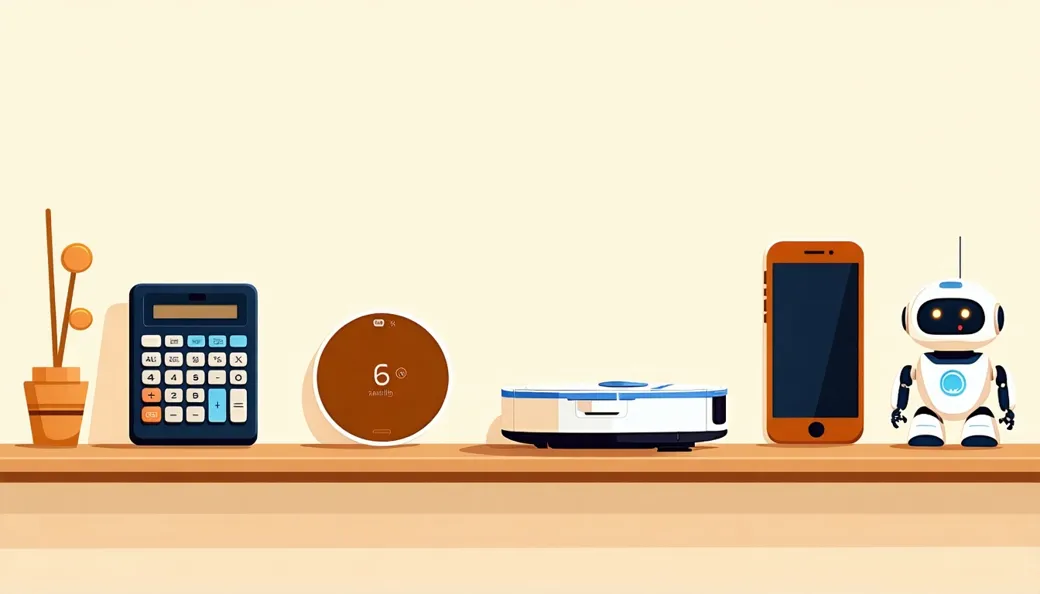
Armed with the two questions — does it follow fixed rules? and did it learn from data? — you can now sort the gadgets in your own life. Try each row yourself before reading the verdict column. Notice that the verdicts refuse to be a clean yes/no: "AI" is a spectrum, and where you draw the line says more about the year than about the machine.
| System | Follows fixed rules? | Learned from data? | Verdict |
|---|---|---|---|
| Calculator | Yes — arithmetic, exactly as programmed | No | Not AI. Nobody ever thought adding needed a mind — it needs bookkeeping. |
| Thermostat | Yes — one rule: below the setpoint, heat on | No (a "smart" one may learn your schedule — that sliver is ML) | Barely AI, and only historically. It senses, thinks, acts — but the THINK beat is one line. |
| Spam filter | A few safety rules on top | Yes — trained on millions of labeled emails | Yes: classic learned AI. So reliable we stopped noticing it — the moving definition at work. |
| GPS routing | Yes — a clever route-search algorithm | Partly — live traffic predictions are learned | Borderline. The search is old-school "good software"; the traffic crystal ball is ML. |
| Face unlock | No usable rules exist for "this is your face" | Yes — learned from millions of faces | Yes: a task no rule-writer could ever specify, only learn. |
| ChatGPT | A thin layer of safety rules | Yes — massively, on much of the internet | Yes: today's headline AI. Learned end to end; Part II opens it up. |
The pattern to take away: the more impossible it is to write the rules by hand, the more "AI" the system feels — and the further down the table you go, the more the learning column carries the load.
Narrow vs. general
Here's the second distinction people constantly blur. Every AI system that exists today is narrow AI: brilliant inside one lane, helpless outside it. The chess engine that crushes grandmasters cannot plan a dinner. The dinner bot cannot play chess. Even ChatGPT — which feels general because language touches everything — is one system doing one trained task (producing text, and lately images and actions) extraordinarily well.
Think of narrow AI as a chess grandmaster who cannot make toast. Decades of practice have carved one skill impossibly deep, but step out of the sixty-four squares and there is simply nothing there — not weak toast-making skills, but no toast-making skills, because nothing in a life of chess ever touched bread. The analogy flatters the machine slightly: a human grandmaster could learn toast in an afternoon, while a chess engine cannot learn anything outside chess at all — its narrowness is structural, not just unpracticed.
General AI (you'll see the acronym AGI, for artificial general intelligence) means a system that could learn any intellectual task a person can, switching lanes the way you switch from driving to cooking to comforting a friend. It does not exist. Whether current techniques scale to it is one of the loudest open arguments in the field — serious researchers sit on both sides, with timelines ranging from "a few years" to "not this century, maybe never with these methods."
| Narrow AI (all of today's AI) | General AI (hypothetical) | |
|---|---|---|
| Scope | One task or task family | Any intellectual task |
| Moving between tasks | Needs retraining or rebuilding | Adapts on its own, like a person |
| Example | Chess engine, spam filter, ChatGPT | None — does not exist yet |
| Should you worry about it today? | Yes — it's deployed everywhere | Debatable — it's a research question |
Why does this distinction matter to you, practically? Because narrowness explains AI's strangest behavior: the same product can be superhuman and clueless within a single minute. A chatbot can pass a medical licensing exam, then confidently lose a game of tic-tac-toe. That's not a bug being fixed next quarter — it's the signature of narrow systems, deep in some grooves and absent from others. Chapter 10 gives this pattern a name (the "jagged frontier") and turns it into a practical skill: predicting where a given AI will shine and where it will faceplant.
Seventy years in one page

AI is not new. It's older than the internet, older than the pocket calculator. What's new is that it finally works for everyday tasks — and knowing the shape of the seventy-year road explains a lot of today's hype and fear.
The walk-through, in five sentences. In 1956, a summer workshop at Dartmouth College launched the field under the name "artificial intelligence" (coined by John McCarthy in the 1955 proposal for the workshop) and predicted rapid success; the founders thought human-level machines were maybe a generation away. The 1970s–80s gave us expert systems — rules-based AI at industrial scale, thousands of hand-written if/then rules capturing (say) a doctor's diagnostic knowledge — which worked, then collapsed under the same brittleness that killed dinner-bot v1, helping bring on the second of the AI winters: long stretches when funding and faith dried up (the first, in the mid-1970s, followed earlier overpromising). In 2012, learning-based AI roared back when a deep neural network (a learning system with many stacked layers — Chapter 2 explains it properly) demolished the field in a famous image-recognition contest, kicking off the deep-learning decade. In 2017, researchers at Google published the transformer, a new learning architecture especially good at language — it's the "T" in GPT, and Chapters 3–4 open it up. In November 2022, ChatGPT wrapped a transformer in a chat window and reached an estimated 100 million monthly users in two months, which analysts at UBS called the fastest-growing consumer app on record at the time; by 2025–26, the frontier had shifted from chatbots that answer to agents that act — systems that can research the restaurant, check your calendar, and book the table (Chapters 8–9).
Misconception: "AI means robots" — and "AI is one thing"
Two corrections in one box. First, AI is not robots. A robot is a body; AI is behavior. Most AI has no body at all — it lives in data centers, ranking your feed and filtering your spam. Most robots, meanwhile, contain barely any AI: a factory arm repeats one motion, blind and mindless. Second, AI is not one thing. It's a family name covering wildly different techniques — hand-written rules, spam-filter-style learners, image recognizers, chatbots — the way "vehicle" covers skateboards and container ships. So the question "Is AI dangerous?" is as underspecified as "Are vehicles fast?" The right response is always: which AI, doing what task?
Since AI is a family name, it helps to see the family tree — and it's not a tree so much as a set of nested circles. Machine learning is one way (now the dominant way) of doing AI; deep learning is one way of doing machine learning; and large language models, the stars of this book, are one application of deep learning. Every LLM is deep learning, every deep-learning system is machine learning, and all of it is AI — but none of those arrows reverse.
Try it now (5 minutes)
Open any chatbot (ChatGPT, Claude, Gemini — whatever you have). Ask the same question twice, in two different chats, worded two ways. First: "What should I get my mom for her birthday?" Then: "My mom is turning 68, loves gardening but her knees are getting bad, and she says she 'doesn't need more stuff.' What should I get her for her birthday?" Compare the answers. Notice two things: (1) unlike dinner-bot v1, the system didn't error out on messy, unanticipated phrasing — it handled "doesn't need more stuff" the way rule 6 never could; and (2) the quality of what you got out tracked the quality of what you put in. Both observations will be explained, mechanically, by the end of Part II.
Where this leaves us
You now have the two axes that organize everything else in this book: rules vs. learning (how the box is filled) and narrow vs. general (how wide the box's lane is). Dinner-bot v1 was rules-based and narrow, and it snapped the moment Mom changed. The obvious next question is the one the whole field asked after the expert-systems collapse: instead of telling the machine the rules, could the machine work out the rules itself, from examples? That is machine learning, and it's next.
Three resources, easiest first
- Easy — Co-Intelligence by Ethan Mollick (2024). A short, warm, zero-jargon book on living and working with today's AI, by a business-school professor who makes his students use it. Read it for judgment, not mechanics.
- Deeper — Artificial Intelligence: A Guide for Thinking Humans by Melanie Mitchell (2019). A researcher walks through the field's history, methods, and honest limits. The best single book on why AI is harder than the headlines say.
- Deepest — Artificial Intelligence: A Modern Approach by Stuart Russell & Peter Norvig. The standard university textbook, 1,000+ pages. Not for reading cover to cover — for looking up any topic in the field and finding it treated seriously. Keep it on the horizon, not the nightstand.