Chapter 17
Working & Learning with AI
The two dinner-table questions this book gets asked most: "should I worry about my job?" and "is it okay that the kids use it for homework?" What the data actually says about both — and the one distinction that answers them together.
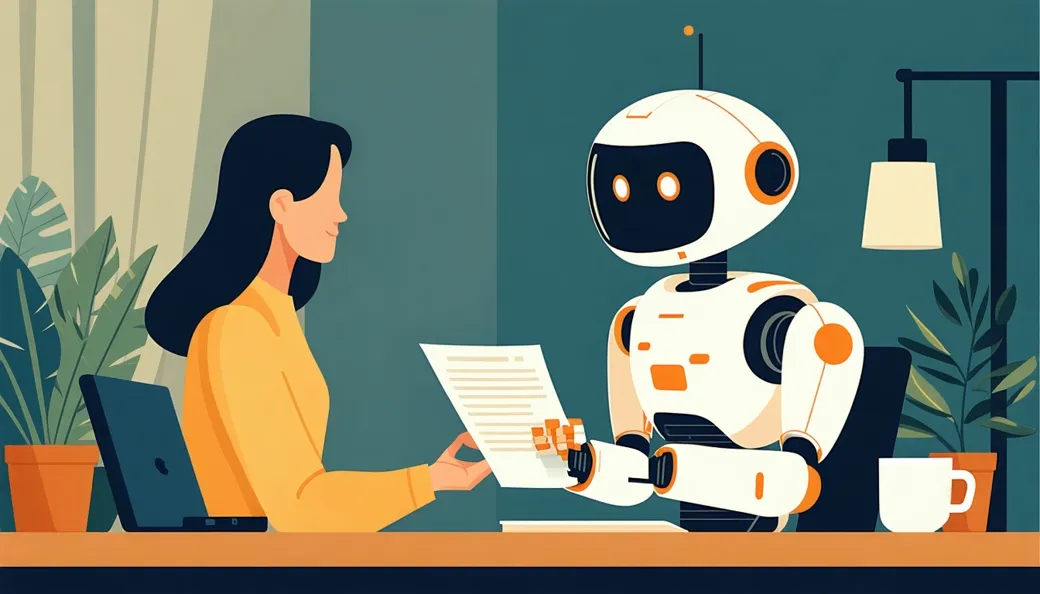
At the birthday dinner itself, between the cake and the coffee, the conversation finally turns to the machine that planned it. Your sister asks the job question — half joking, not really joking. Your nephew, sixteen, mentions a little too casually that ChatGPT "helped" with his history essay. Two anxieties, one root: what happens to human skill when a machine can do the skilled thing? This closing chapter takes both seriously, with receipts — usage data from millions of working conversations, and a brain-imaging study of students writing essays — and ends with the single question that sorts nearly every "should I use AI for this?" dilemma you'll face.
What AI at work actually looks like, measured
Set aside prediction and look at observation. In February 2025, Anthropic launched the Anthropic Economic Index: roughly one million anonymized Claude conversations, analyzed with privacy-preserving tools and matched against the U.S. Department of Labor's catalog of about 20,000 work tasks. Three findings deserve a place in your sister's answer:
- AI arrives task by task, not job by job. About 36% of occupations showed AI use in at least a quarter of their tasks — but only about 4% showed it across three-quarters or more. The unit of change is the task: the memo's first draft, the spreadsheet formula, the meeting summary. Whole jobs are bundles of tasks, and the bundle is proving much harder to swallow than any single piece. That's Chapter 10's jagged frontier, showing up in payroll form.
- Collaboration outweighs replacement — for now. 57% of the usage leaned toward augmentation — the human iterating, checking, learning, with the model as collaborator — versus 43% toward automation, where the model just does the thing. The balance will keep shifting, but today's typical AI-at-work moment is a person and a model passing a draft back and forth, not a person being walked out.
- Usage is lopsided. Computer and mathematical tasks accounted for 37.2% of the conversations, from a field that's only about 3.4% of U.S. workers. Programmers got there first — partly because code is checkable, Chapter 12's favorite property. Where your field sits on that curve tells you how much time you have to get deliberate.
So the honest job answer isn't "safe" or "doomed" — it's: list your tasks. Some are already cheap to delegate (the frontier's strong side); some remain stubbornly yours (judgment, relationships, accountability, the physical world); and the working skill of the decade is being the person who knows which is which, drives the model well (Chapter 6), and — because Chapter 10 taught you the model is confidently fallible — owns the verification. In an office where drafts are free, the person whose name means "this was checked" gets more valuable, not less.
The learning trap: when the tool does the growing for you
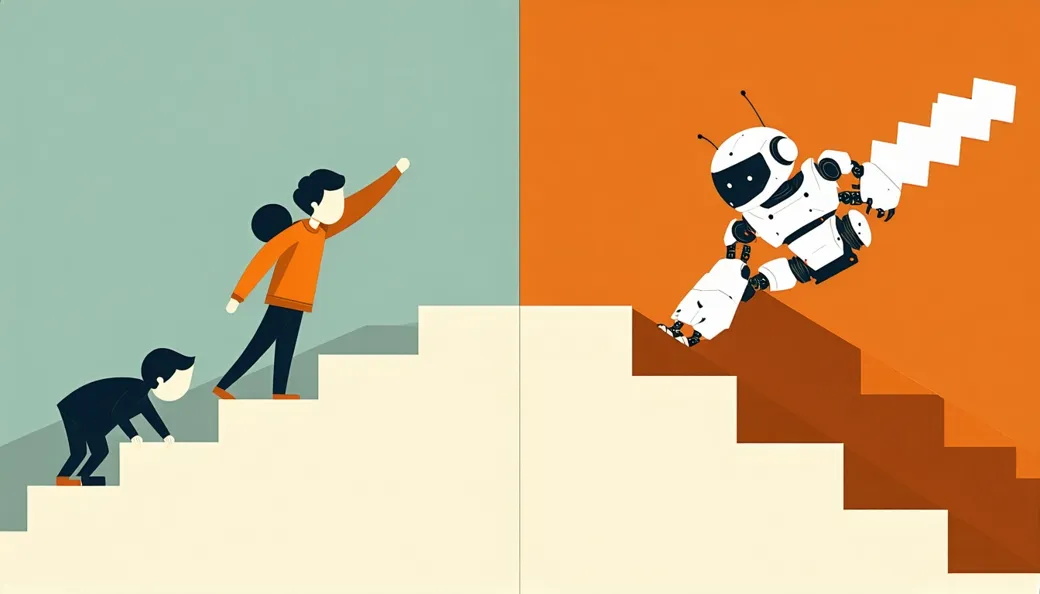
Now the nephew. Here the same magic — instant competent output — has a sharper edge, because at work the deliverable is the product, but in school you are the product. The essay was never the point; the changed brain that comes from wrestling with the essay was.
In 2025, MIT Media Lab researchers ran a widely discussed demonstration, memorably titled "Your Brain on ChatGPT." Fifty-four participants wrote essays across multiple sessions — some with ChatGPT, some with a search engine, some with nothing but their heads — while EEG caps recorded their brain activity. The pattern was blunt: brain-only writers showed the strongest, most widespread neural engagement, search users came second, and ChatGPT users the weakest — over months of sessions, the LLM group "consistently underperformed at neural, linguistic, and behavioral levels." The details sting more than the headline: LLM users "struggled to accurately quote their own work" minutes after submitting it, and reported the weakest sense that the essay was even theirs. The authors' framing: "While LLMs offer immediate convenience, our findings highlight potential cognitive costs" — they call the pattern accumulating cognitive debt. Borrow the machine's effort today, and the interest is skill you never built.
None of this says the nephew's generation is doomed; it says how they use it decides everything. Learning science has known the mechanism for decades — memory and skill are built by effortful retrieval and struggle, not by exposure to answers. A tool that removes the struggle removes the learning, exactly the way being driven around a city for a year teaches you no routes.
The fix the labs shipped: modes that refuse to just answer
The remarkable development of 2025 is that the AI labs said the quiet part themselves — a chatbot's default behavior is optimized for finishing, not learning — and shipped a different mode. OpenAI's study mode (July 2025), built "in collaboration with teachers, scientists, and pedagogy experts," flips ChatGPT from answer-machine to tutor: it uses "Socratic questioning, hints, and self-reflection prompts to guide understanding" — Socratic meaning it teaches by asking you questions instead of handing you answers — scaffolds material into steps, and quizzes as it goes — the stated goal being that students "learn something—not just finish something." Anthropic's Learning Mode (April 2025) is the same bet: instead of solutions, Claude opens with "How would you approach this problem?" and presses with "What evidence supports your conclusion?" And the two threads of Part V braid together: ChatGPT's parental controls (Chapter 15) let a parent make study mode the default for a teen's new chats.
Notice what a study mode really is, mechanically — you can now see it: a system prompt steering the same next-token machinery from "produce the essay" toward "produce the question that makes the student produce the essay." Which means you don't have to wait for a toggle; the mode is also a sentence you can type. "Don't give me the answer — quiz me toward it." "Explain, then make me do the next one alone." "Find the flaw in my proof, but only hint at where." The tutor was in there all along; the default just never asked.
One question, asked every time
So the rule that closes this book is a single question to ask before any AI-assisted task: is this a doing task or a learning task? If the deliverable is the point — the work memo, the dinner logistics, the form letter — delegate hard, then verify like Chapter 10 taught you. If a more capable you is the point — the student's essay, the new skill your job now demands, the language you're learning — flip the mode: make the machine ask, hint, and quiz, and keep the struggle for yourself. Same model, same chapter of physics homework, opposite correct answers. Tell the nephew both halves: using AI on the essay isn't the sin; using it in the wrong lane is.
And that's the book. You can now explain the whole ladder — AI, machine learning, language models, agents — and you've toured the world they're building: the toggle that buys thinking, the voice that isn't proof, the image that needs provenance, the friend with a tilt, the agent at the checkout, and the two lanes of work and learning. The machine that planned Mom's birthday dinner is the same machine in all seventeen chapters: a pattern-completer of astonishing range, no judgment of its own, and exactly as good for your life as the judgment you bring to it. That judgment was the deliverable of this book. It was a learning task. Thanks for doing the struggle.
Misconception: "Watching the AI solve it teaches me to solve it"
This is the era's most tempting study strategy, and it fails for a reason you can now name. Watching a solution feels like learning because recognition is easy — "yes, that makes sense" — but recognition and production are different skills, stored differently. The essay study made this concrete: students who wrote with the LLM couldn't accurately quote their own submitted essays minutes later, because fluent output had flowed past them without ever being constructed by them. It's the difference between watching someone drive and being able to drive. The fix costs one sentence: after any AI explanation, close the chat and redo the problem — or re-explain the idea — with the machine gone. If you can't, you didn't learn it yet; you only agreed with it.
Simplified!
Honest fine print on both datasets. The brain study: 54 participants (only 18 returned for the crossover session), one kind of task (essays), and EEG "connectivity" is a measure of engagement during the task — not proof of lasting damage; it's a serious early warning, not a verdict, and it was posted as a preprint — shared before other scientists had formally reviewed it. The Economic Index: it measures conversations with one company's model, overrepresents programmers, and is a snapshot of early 2025 — the 57/43 augmentation-automation split describes how people were using it, not a law of nature, and the balance has already moved: in Anthropic's later reports, automation briefly overtook augmentation on Claude.ai (August 2025 data), then slipped back behind it, 45% to 52%, by November 2025. Both point the same direction; neither settles the future. That's the normal condition of live science, and Chapter 10 taught you how to read it.
Try it now (two 10-minute sessions, one day apart)
Run the two-lane experiment on yourself. Pick two small topics you genuinely don't know (say, how mortgage points work, and why planes stall). Topic A: doing mode — ask for the explanation, read it, move on. Topic B: learning mode — turn on study/learning mode if your app has one, or type: "Don't explain this to me yet. Ask me questions until I figure it out, giving only hints." Tomorrow, close everything and write three sentences about each topic from memory. Almost everyone finds Topic B survived the night and Topic A evaporated — and feeling that difference once, in your own head, will do more than any study cited above. Then teach the trick to the nephew.
Where to go deeper
- Easy: OpenAI's study mode announcement — short and readable, with the learning-science reasoning spelled out; useful for any student or parent deciding how AI belongs in homework.
- Medium: The Anthropic Economic Index — the task-level view of AI at work: the augmentation/automation split, which occupations lead, and open data that updates as the picture shifts.
- Deep: "Your Brain on ChatGPT" (Kosmyna et al., MIT Media Lab) — the essay-writing EEG study behind "cognitive debt"; long, but the methods and the session-four crossover are worth seeing firsthand before you quote the headline.