Robotics · News · 3 min read
ETH Zurich robot hand walks on its fingers and presses keys
A five-fingered robot hand learned to crawl, stand back up and push a block, all in simulation first. It shows how robots learn movement before touching the real world.
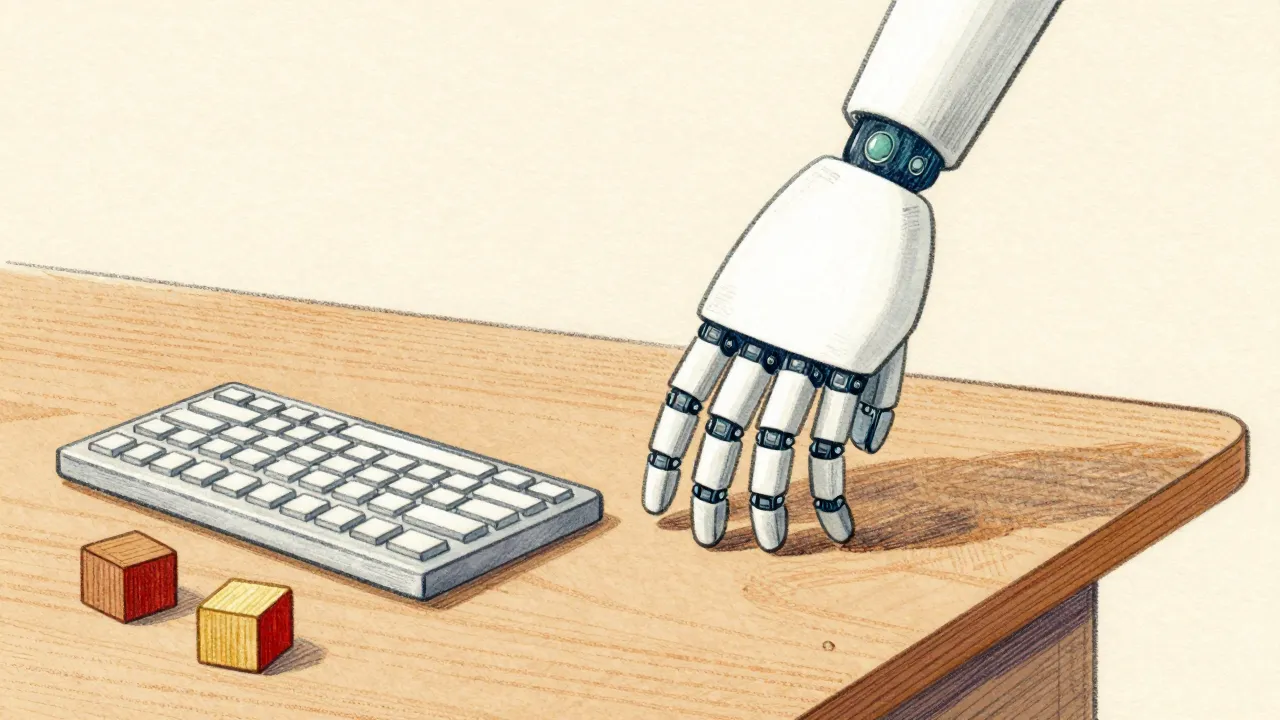
Researchers at ETH Zurich’s Soft Robotics Lab posted a paper on 15 September 2026 describing a robot hand that uses its fingers as legs. The authors are Amirhossein Kazemipour, Hehui Zheng and Robert Katzschmann. The work is a preprint and has not yet been peer reviewed.
The team took an off-the-shelf, human-shaped hand with five fingers and 20 powered joints, and added a small module with a battery, sensors and a computer. The whole unit weighs 818 grams and runs without cables.
According to the project page, the hand crawled across 14 indoor and outdoor surfaces, including grass, gravel and asphalt. It stood itself back up after falling in 21 of 25 tries. Balancing on four fingers, it used the fifth to press the arrow key a person asked for 29 times out of 32, without using a camera, after the keyboard had been lined up with the hand. Guided by an overhead camera, it pushed a small cube to a target with an average error of 17 millimetres across 15 runs.
The hand learned these skills by trial and error in a computer simulation, using a method called reinforcement learning, before the skills were moved onto the real hardware.
Why it matters
A human hand has a long thumb and fingers of different lengths. That shape is good for gripping and awkward for walking, so the robot had to learn a gait that suits it. Training in simulation lets a robot practise thousands of falls without breaking anything. The hard part is making the simulator match reality closely enough, which the team did by measuring the real hand first. Our Robots in the Room course explains this “practise in simulation, then transfer” approach.
How often the walking hand succeeded
Sources
 Go deeper · guided courseRobots in the RoomWhy the physical world is the hard part, and what is changing now.Starts with: Hands are hard · 11 minStart the course →